

The last several years have seen an explosion in connected devices, such as smart home devices and industrial sensors, immersing more products into the Internet of Things ecosystem. With the increase in IoT systems, companies have come to realize the difficulty of managing thousands or millions of devices through traditional methodologies.
Historically, organizations relied on DevOps as a method to speed up software delivery and improve collaboration. While DevOps is still relevant, IoT companies are now transitioning to platform engineering, a more scalable and structured approach. Gartner data reinforces this massive shift, predicting that 80% of large software engineering organizations will operate dedicated platform engineering teams by 2026, up from just 45% in 2022. This transition is not merely a fad but is in direct response to the challenges faced in building, deploying, and maintaining large-scale IoT systems
Why IoT is pushing systems beyond traditional DevOps
The way that IoT works differs significantly from traditional web and mobile applications. With IoT, you have the added complexity of having to deal with a number of variables, including hardware (i.e., physical devices), cloud services, edge devices, firmware updates, and continuous streams of sensor data being generated by your devices.
The traditional approach to DevOps was primarily focused on the application/software development pipeline and deploying code onto servers or cloud solutions. Although DevOps has worked well in those settings, it does not work well in IoT. DevOps systems were not designed for such an extensive and distributed set of applications. The devices will be distributed across multiple geographic locations and may consume a variety of hardware resources; therefore, they have limited or no connectivity to the internet.
At this point, it is apparent that DevOps lacks many of the features and capabilities needed to manage these environments effectively because there will not be an efficient way to manage application updates or monitor device health and ensure network security for a large, distributed set of applications that make up an IoT environment since they are so varied between different devices/applications; therefore, IoT companies are looking for a single system that will provide a unified view of all of the variable components of their applications/devices within a single, scalable framework.
The challenges DevOps faces in IoT environments
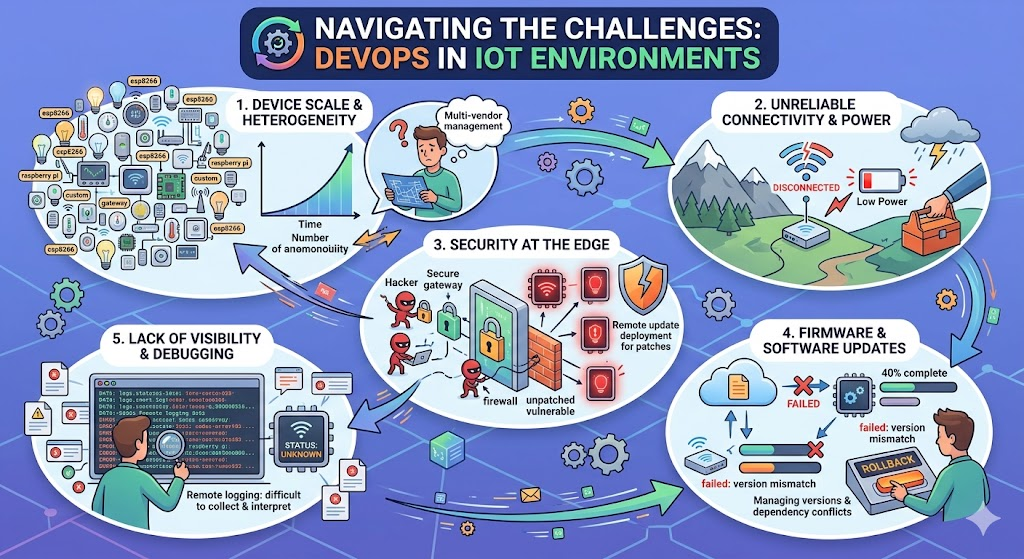
Scale is a major issue in IoT, as a single IoT platform may serve thousands and/or millions of devices. Each device will need to receive firmware updates, security fixes, and real-time monitoring, so doing this manually and/or through traditional pipelines can lead to chaos very swiftly.
Another dilemma is consistency. In DevOps, we commonly focus on how applications are deployed. However, IoT systems need to be consistent across software and hardware layers on every single one of their devices. If a given device has an alternate version of an application or an alternate configuration, this can create failures or become a security risk.
Distributed computing adds to the challenge with edge computing—many IoT devices keep track of and process local information before it is sent to the cloud. As a result, DevOps pipelines are not typically structured for effectively managing this type of distributed computing model.
Finally, there is the issue of security. Through the use of so many connected endpoints, IoT systems can become susceptible to vulnerabilities without appropriate management of updates and access controls. Traditional DevOps tools may find it challenging to maintain control across such a large scale.
Why platform engineering is becoming the preferred choice
To understand why we need to use platform engineering, we can look at how organizations treat infrastructure. They typically see their infrastructure as a bunch of different tools or processes, and they manage them separately. With a platform engineering solution, we create an internal platform that connects all our infrastructure into one cohesive whole, rather than treating them as separate tools or processes.
To put it another way, platform engineering creates what we call a self-service layer for developers and IoT teams. When developers have access to this self-service layer, it hides the complexity of building things and allows us to provide consistent tools for deploying, monitoring, and scaling things. According to developer environment research published by Forbes, 63% of engineers waste over 30 minutes every day simply navigating knowledge silos and searching for answers to problems, which directly underscores the critical need for a streamlined developer experience. When we think of DevOps, we often think about the use of many different unconnected tools.
How platform engineering solves IoT complexity
Numerous IoT companies have to contend with huge amounts of incoming data and interactions with devices, both of which create many requests per second. With platform engineering, IoT companies can provide reusable components and automated workflows to improve efficiency for developers.
Centralized control is one major benefit of using platform engineering within an IoT company. Instead of having to manage each device separately (both before and after deployment), teams are able to use the same platform to manage groups of devices. By managing devices via the same platform, teams can easily manage the deployment of new updates and also be able to track each device’s performance and the enforcement of any security policies.
Another benefit is that there is scalability. With the growing number of IoT networks, the ability of platform engineering to allow for growth without rebuilding or making major changes to the architecture of a system is critical. This is particularly true in industries such as smart cities, healthcare devices, and industrial automation.
Platform engineering also improves developer experience by freeing them from having to worry about infrastructure considerations each time they deploy a new feature. Developers can now focus on delivering functionality rather than dealing with the operational complexity that comes from managing an infrastructure solution.
The role of automation and standardization
While automation serves as a cornerstone for both DevOps and platform engineering, its application varies considerably between these two disciplines.
With respect to IoT-focused platform engineering, automation goes well beyond just CI/CD (Continuous Integration/Continuous Deployment) pipelines. It also encompasses device onboarding, configuration management, monitoring, and predictive maintenance for future reference.
Similarly, establishing a standard is critical in providing predictability and consistency across many different types of IoT devices from multiple manufacturers that may run on different operating systems.
These two factors combined reduce the risk of errors and improve the overall reliability of IoT deployments at scale, consequently decreasing the amount of effort required by engineering teams to support hundreds of devices with multiple configurations.
Why IoT companies are making the shift now
As IoT has matured into a fully developed industry and is being used at scale in critical industries (e.g., manufacturing, healthcare, logistics, and smart infrastructure), there continues to be a shift toward platform engineering to provide a stronger foundation for long-term organizational growth. Previously, organizations were experimenting with connected devices but have now begun utilizing IoT to run their businesses with the potential to serve customers directly. With so many users utilizing these industries today, a small number of inefficient processes can easily lead to large-scale issues.
An example of this is the instantaneous impact of downtime, security incidents, or an unsuccessful software update on thousands of users at the same time. Traditional DevOps practices still have value; however, their use without additional supportive infrastructure will no longer be adequate as organizations look to provide their organization with the stability needed to grow in the future. As a result of this, a vast number of organizations are now investing in internal platforms that consolidate everything into a single system.
The future of IoT development
As IoT technology grows, the importance of platform engineering is also going to grow. More advanced intelligent systems will be built that can heal themselves, update themselves automatically, and detect when an issue may arise before it occurs.
Due to the expansion of automated and AI-driven infrastructures, IoT systems will be able to operate on their own, rather than relying on human involvement.
As organizations seek to innovate quickly while reducing complexity, the need for platform engineering will continue to increase.
Over time, the combination of IoT and platform engineering will make it possible to create, manage, and scale connected systems within a variety of industries.
Conclusion
Platform engineering can be thought of as a response to the increasing complexity of IoT. As IoT becomes larger and more essential, it will no longer be enough for companies to manage devices, data, and infrastructure without adding additional issues regarding operational burdens. In an attempt to create a single unified methodology using structure, automation, and scalability, platform engineering helps create a way for IoT companies to work.
By utilizing tools and processes in a more organized and coordinated way, IoT companies are able to create a platform for their development process that streamlines not only deployment but also monitoring. As the IoT landscape continues to grow, the importance of transitioning from DevOps to platform engineering will continue to increase in the near future.