Small businesses used to compete on location, price, and relationships. In 2026, a new layer has been added: intelligence.
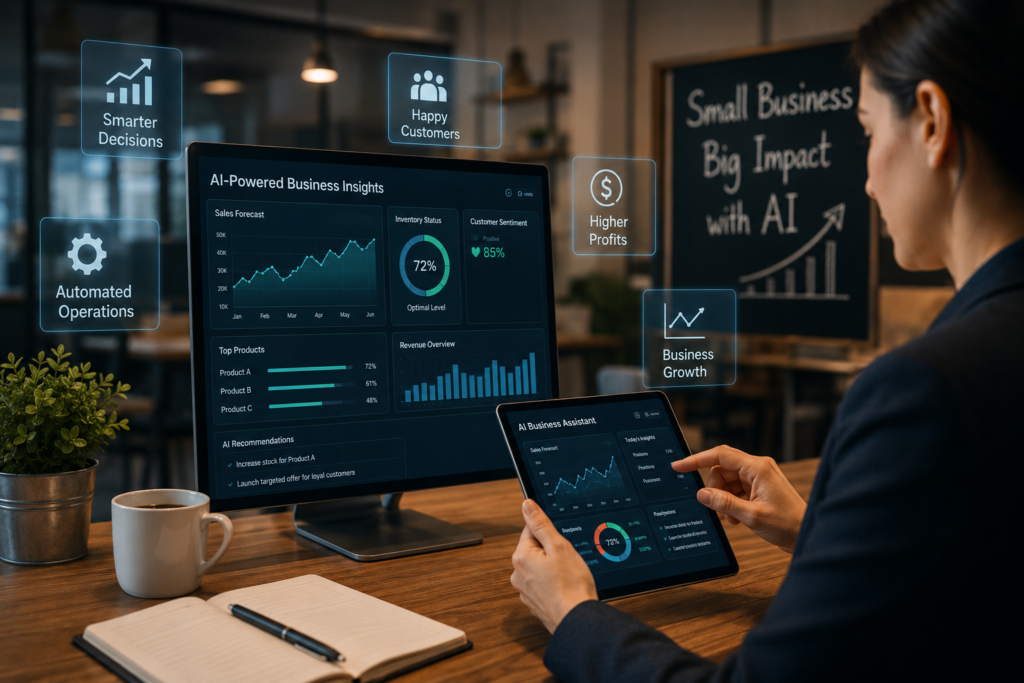
The businesses pulling ahead are not just working harder. They are working with software that learns, adapts, and surfaces the right decisions at the right time. That is what data-driven software development has made possible, and it is no longer a technology reserved for large enterprises with large budgets.
According to Stanford HAI’s 2026 AI Index, organizational AI adoption has reached 88%. According to AppVerticals, 78% of organizations have already integrated AI into at least one business function, up from 55% just two years ago.
The gap between businesses using this and businesses that are not is widening every month. This article explains what is actually happening, what it means for small businesses, and what you need to know before you invest in it.
What Is Data-Driven Software Development?
Most people hear “AI app development” and picture chatbots or automation scripts. The reality in 2026 is quite different.
Data-driven software development means building applications that improve through real-world data rather than staying fixed at whatever logic was written at launch.
Here is the clearest way to see the difference:
- A standard booking system records appointments.
- A data-driven booking app notices Tuesday mornings have high cancellation rates, predicts which upcoming slots are at risk, and sends reminders automatically before cancellations happen.
In 2026, this kind of application is built on three things working together:
- Data pipelines that collect signals from every interaction
- AI models that find patterns in that data
- Feedback loops that make the application more accurate over time
Why Small Businesses Are Winning With This Right Now
Large companies have used data and business intelligence for years. But here is what has genuinely changed in 2026 for smaller operations:
The infrastructure barrier is gone.
Cloud platforms like AWS, Google Cloud, and Microsoft Azure offer on-demand computing on a pay-as-you-use model. A small business application can run lean during quiet periods and scale automatically during peak traffic with no manual setup, no server rooms, and no IT department needed.
Pre-trained AI models do the heavy lifting.
You no longer need a data science team to build intelligence into software. Pre-trained models from OpenAI, Google, and others can be configured and fine-tuned for a specific business problem in weeks, not months.
The Salesforce SMB Trends Report.
confirmed that the businesses reporting the strongest AI results were not the ones with the biggest budgets. They were the ones who treated AI as a continuous operational capability rather than a one-time project.
Small businesses move faster than enterprises. Fewer decision layers. Less legacy infrastructure. That speed advantage, combined with modern software development services, means small businesses can get to real results faster than the large competitors they are chasing.
Real Industries. Real Transformation.
Retail
- AI apps forecast demand at the product-category level week by week, not season by season
- Personalised recommendations built into customer apps using real purchase behaviour data
- Overstocking and dead stock problems are reduced through intelligent restocking alerts
- Shopify merchants integrating AI inventory tools have reported measurable improvements in cash flow
Healthcare
- Small clinics use AI applications for appointment management, waitlist handling, and patient communication
- Automated reminder systems learn which patient segments cancel most and adjust outreach accordingly
- Administrative tasks that used to take hours of staff time per day are handled by the application
- Healthcare generates 30% of the world’s data; AI is what finally makes that data useful at any clinic size
Finance and Professional Services
- Accounting firms and financial advisors use AI apps that surface proactive client insights
- Applications flag cash flow risks three to four weeks before they become emergencies
- Compliance summaries and risk predictions generated automatically from live transaction data
- The service model shifts from reactive reporting to proactive guidance, a fundamentally different value proposition
The Tech Stack Behind It (Simplified)
You do not need to understand every component. But knowing what goes into a modern AI application helps you ask better questions when evaluating a development partner.
| Layer | What It Does | Common Tools |
| Data pipelines | Collect and move data between systems in real time | Snowflake, Databricks, custom ETL |
| AI and ML models | Find patterns, make predictions, personalise output | OpenAI, Google Vertex AI, AWS SageMaker |
| Backend and APIs | Connect the AI layer to the application logic | Node.js, Python, scalable REST or GraphQL APIs |
| Frontend | Deliver the experience to users | React, Next.js, native iOS and Android SDKs |
| Monitoring | Track performance and catch model drift | MLflow, Firebase, New Relic |
The right combination depends entirely on the business problem being solved. A demand forecasting tool needs a different stack than a customer-facing personalization engine.
The 6-Stage AI App Development Process
Whether you are building from scratch or adding AI to an existing system, the development process follows a clear sequence. Skipping stages is where most projects fail.
1. Discovery and Strategy: Define the specific business problem, the data that exists, and what a measurable outcome looks like. This stage prevents building the wrong thing efficiently.
2. Design and Prototyping: Map how users will interact with AI-powered features. Build for explainability—users should understand why the application is making the suggestions it makes.
3. Model Selection: Choose between a pre-trained model, a fine-tuned model, or a custom-trained one based on how specific the problem is. Most small business use cases start with fine-tuned pre-trained models.
4. Testing Against Real Data: Test against actual operational data, not controlled samples. An application that performs well in staging and poorly in production is worse than no AI at all.
5. Deployment and MLOps: Automate the build, deploy, and retraining pipelines so the application stays current as business conditions change.
6. Continuous Improvement: Establish feedback loops and usage analytics from day one. An AI application that is not improving after launch is losing value relative to one that is. According to research cited by Modall, only 25% of AI initiatives have delivered expected ROI. The bottleneck is almost never the technology. It is implementation discipline and the clarity of the problem being solved.
Is Your Business Ready?
Before committing to building a data-driven application, answer these four questions honestly:
1. Do you have consistent, structured operational data?
Two-plus years of digital transaction records is enough to start with. Paper records and disconnected spreadsheets need to be solved first.
2. Can you name one specific high-value problem to start with?
Demand forecasting, customer churn, appointment management, and route optimization: one focused problem delivers more value faster than trying to make everything intelligent at once.
3. Does your team have the capacity to act on the intelligence the application produces?
AI surfaces insights. Humans still need to act on them. If your team is already at capacity, the application needs to automate the action, not just surface the information.
4. Are you prepared for continuous iteration after launch?
The strongest AI applications improve over three to six months of real-world use. Treating launch as the finish line means you never get the full value of what was built.
How to Choose the Right Development Partner
Not every custom software development team is equipped to build data-driven applications. The skills required — data architecture, model integration, real-time processing, and ongoing MLOps—are different from standard web or mobile development.
Green flags to look for:
- They ask about your operational data before recommending a solution
- They can demonstrate working AI applications they have built, not just concept mockups
- They explain data architecture clearly — where data lives, how it moves, how it is used
- They treat post-launch improvement as a planned deliverable, not an optional extra
- They recommend starting focused rather than trying to build everything at once
Red flags to avoid:
- Leading with technology recommendations before understanding the business problem
- Offering analytics as a “future phase” rather than a core design element
- No clear methodology for how the application improves after it goes live
- Promising results without discussing data readiness first
FAQs
1. What is data-driven software development in simple terms?
It is the practice of building software that uses real business data to improve its behavior over time. Instead of doing exactly what it was programmed to do at launch, the application learns from how it is used and becomes more accurate, personalized, and useful as it collects more real-world signals.
2. How much does AI app development cost for a small business?
A focused proof-of-concept around one specific use case typically takes four to six weeks. A production-grade application with full data pipelines and continuous learning capability usually runs twelve to twenty weeks. The relevant measure is return on investment—what the application enables versus what it costs to build and maintain.
3. Do small businesses need large amounts of data to start?
No. Many small business AI applications start with pre-trained foundation models that are adapted using a smaller set of business-specific contexts. Two or more years of consistent operational records is enough to build meaningful intelligence for most focused use cases.
4. What is the difference between business intelligence and predictive analytics?
Business intelligence shows you what has happened and what is happening now. Predictive analytics uses that historical data to forecast what is likely to happen next. Both are components of a well-built data-driven application. For most small businesses, business intelligence delivers immediate value, and predictive analytics becomes more accurate as the data set grows.
Conclusion
Data-driven software development is not a future investment anymore. It is the present-day difference between businesses that make decisions from real intelligence and businesses that make decisions from memory and intuition.
The tools are accessible. Cloud infrastructure has removed the cost barrier. Pre-trained AI models have removed the technical barrier. Focused software development services built specifically for growing businesses have removed the complexity barrier.
What remains is execution, choosing the right problem to start with, working with a development partner who understands both the technology and your business, and committing to improving the application after it is live rather than treating launch as the end of the project.
The businesses that will lead their markets over the next three years are building this foundation right now. The ones still waiting are making a choice that will cost them later.