
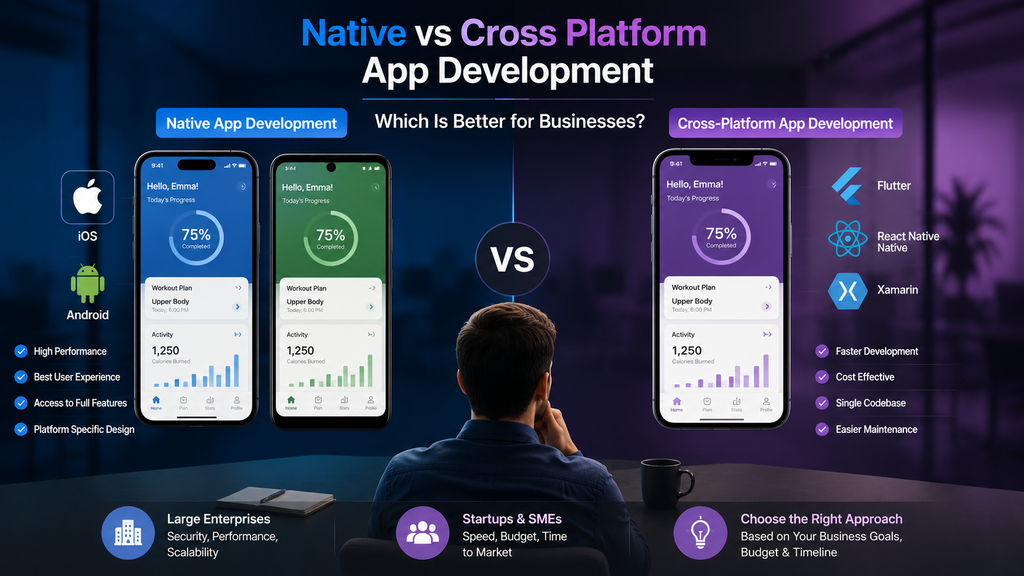
Two founders sit down with their development budget and hit the exact same fork in the road almost every mobile app project eventually reaches: build separately for iOS and Android, or build once and deploy everywhere. It sounds like a purely technical question, but it’s really a business question wearing technical clothing, one that affects how much gets spent, how fast the app reaches users, and how painful future updates will be. Cross-platform app development companies have become the default starting point for a huge share of businesses tackling this decision, largely because they solve the two constraints founders feel most acutely: limited budget and limited time.
This isn’t a case where one approach is objectively superior. It’s a case where the right answer depends entirely on what a specific business actually needs, and too many companies pick a side based on trends rather than their own real requirements.
Getting Past the Marketing Noise
Both approaches have vocal advocates, and both sides tend to oversell their case. Native development gets pitched as the only “real” way to build a proper app, while cross-platform gets pitched as having fully closed the gap with no meaningful trade-offs left. Neither claim holds up perfectly under scrutiny. The honest picture is more nuanced, and understanding it properly is what actually leads to a smart decision.
Native Development: What It Delivers and What It Costs
Native apps are built specifically for one operating system, using that platform’s own programming language and tools, Swift for iOS, Kotlin for Android. Each platform gets its own dedicated codebase, built and maintained independently.
The payoff is real. Native apps typically deliver the smoothest performance, the most seamless access to device hardware, and an experience that feels perfectly at home on whichever platform it’s running on. For apps pushing hard on performance, advanced games, augmented reality, and apps leaning heavily on specific device sensors, native remains the safer choice.
The cost is real too. Building and maintaining two separate codebases means, in most cases, two separate development efforts, which translates into a bigger budget and a longer runway before launch. Every new feature or fix has to be built and tested twice.
Cross-Platform Development: What It Delivers and What It Costs
Cross-platform frameworks let developers write one codebase that runs on both iOS and Android, translating that shared code into apps that behave natively on each platform. This approach has matured enormously over the past several years, what used to mean visibly compromised performance now often produces results that are difficult to tell apart from native builds for most standard business applications.
The upside is significant: lower development costs, faster time-to-market, and a single codebase that’s considerably easier to maintain and update going forward. For businesses testing a new idea, launching under time pressure, or working with a leaner budget, this approach removes a lot of the friction native development introduces.
The trade-off shows up mainly at the edges: apps with extremely demanding performance needs or apps that need to be the first to adopt brand-new, platform-specific features the moment they’re released. For most business apps, though, these edge cases rarely apply.
A More Useful Way to Compare Them
Rather than treating this as native versus cross-platform in the abstract, it helps to compare them against what actually matters for a specific business.
Budget realities. Cross-platform development generally costs less upfront and over time, since there’s one codebase instead of two. Native development requires a bigger investment, which only makes sense when the performance or platform-specific benefits genuinely justify it.
Speed to launch. Businesses racing to capture a market opportunity or beat a competitor to launch almost always benefit from a cross-platform’s faster development timeline.
App complexity and performance needs. Apps built around cutting-edge graphics, complex real-time processing, or deep integration with the latest device hardware still lean toward native, where performance headroom matters most.
Long-term maintenance capacity. A single, smaller development team maintaining one shared codebase is often more sustainable for a growing business than managing two parallel native teams indefinitely.
Audience and platform priorities. Businesses whose users are heavily concentrated on one platform sometimes find that native development for that single platform makes more sense than optimising for both simultaneously.
The Framework Landscape Businesses Are Actually Choosing From
Cross-platform development isn’t a single tool; it’s an entire category, and the specific framework chosen shapes performance, developer availability, and long-term flexibility. When evaluating the Top 5 Cross-Platform Frameworks for Mobile App Development, most businesses end up comparing Flutter, React Native, Xamarin, Ionic, and NativeScript, each bringing different strengths around rendering performance, community support, and how closely the final result mirrors a fully native experience. The right choice within this category depends heavily on the specific technical requirements of the app and the skill set already available on the development team.
Why Many Businesses Land on a Hybrid Strategy
A growing number of businesses avoid treating this as a permanent, one-time decision entirely. They launch cross-platform to validate an idea quickly and affordably, gather real user feedback, and only invest in a native rebuild once the app has genuinely proven its value and justifies the larger commitment. This staged approach considerably reduces financial risk compared to committing to full native development before knowing whether the app will resonate with users.
What This Decision Really Comes Down To
Stripped of the marketing noise, this decision comes down to three practical questions: How much budget and time does the business actually have? How demanding are the app’s technical and performance requirements? And how important is it that the app feels perfectly native on each platform versus simply working well and reaching users quickly?
Businesses that answer these questions honestly, rather than defaulting to whichever approach sounds more impressive, tend to end up with apps that genuinely fit their situation instead of apps built around an assumption that never quite matched their actual needs.
Final Thoughts
Neither native nor cross-platform development wins this comparison universally, no matter how confidently either side gets pitched. The right choice depends on a business’s specific budget, timeline, technical requirements, and long-term plans for the app. Businesses that take the time to genuinely evaluate their own priorities rather than following whatever approach happens to be trending consistently end up with apps that serve their actual goals, launched at a cost and speed that actually make sense for where the business stands today.