
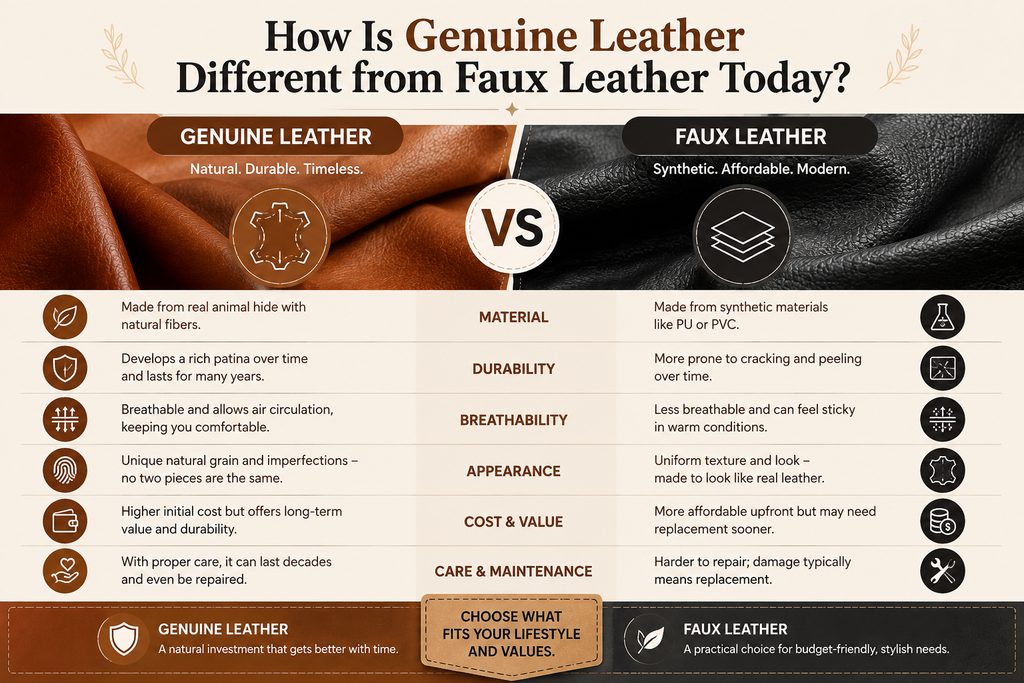
Ten years ago, spotting fake leather was easy. It looked plastic because it basically was plastic: shiny, stiff, obviously synthetic. That’s not the case anymore. In 2026, faux leather may trick a seasoned examiner at first sight, leaving the question not of “which looks better in the store” but “which is the leather?” Which one looks good five years from now and is used every day in your closet? That’s where the divide between real and fake hasn’t narrowed in any way, quite the opposite.
The Myth That Refuses to Die
Somewhere along the way, people started assuming faux leather and genuine leather were just two flavors of the same thing, one cheaper, one pricier, otherwise similar. They’re not. One is animal hide, tanned and treated. Plastic is the other, typically either polyurethane or PVC, designed to look like “hide” visually. They are not the same in years, they are not the same in crisis, and they are certainly not the same in duration. It is when they compare them with each other, as if they are made of the same materials and the same equipment, that most buyers are misled.
What Actually Happens as Faux Leather Gets Older
This is the part showrooms never show you. New faux leather looks impressive: smooth, glossy, evenly colored. Polyurethane coatings, however, tend to degrade over time, even if they are stored without being used. After about 2 years to 5 years (depending on quality), the surface begins to flake, peel, or become brittle. This stage is not something that you can remedy. The product is finished once the coating erodes, no matter how gently the product is treated.
What Actually Happens as Genuine Leather Gets Older
Real hide does the opposite. Authentic leather develops what’s often called a patina, a richer, deeper tone and softer texture that builds with use. Creases from every day wear no longer look like wear and tear, but like character. This is not marketing hype; it’s chemistry. Natural leather fibers are oil-, movement-, and light-resistant; synthetic polymers can’t.
The Environmental Story Isn’t as Simple as It Sounds
Faux leather often gets marketed as the responsible choice, and there’s a real conversation to be had about tanning processes and animal sourcing. However, there is an environmental price tag attached to the plastic leather: It’s made from fossil fuels, and it doesn’t decompose. It’s not as if five faux products were replaced every three years and ended up getting tossed, and a long-lasting genuine leather product that lasts 15 years has a smaller footprint. Environmental factors also play a role in longevity, and it is one area where faux leather continually fails.
The Price Comparison People Get Backward
Here’s an angle that surprises most buyers: Faux leather isn’t necessarily the most “smart” budget option, as most buyers think. The true cost per year can be cheaper for a well-sourced, genuine leather bag, as it may need replacement every 2 years, whereas a synthetic bag may be cheaper initially. That is how we design our pricing, by eliminating the “branding tax” that most retailers impose on a leather product that is truly leather, without any unnecessary extras.
Where Faux Leather Actually Makes Sense
To be fair, faux leather isn’t without a place. It’s a good option for cheap furniture, some stylish items that are designed as fashion statements instead of investments, or people who have specific ethical beliefs about animal products. The standard applies to something built today: a personalized leather messenger bag USA craftsmen construct by hand isn’t just a style choice; it’s a bet that the material underneath will actually go the distance.
The error was not in taking the decision to use faux leather, but rather in assuming it would behave and age like actual leather when it was fundamentally incapable of doing so.
The Details That Give It Away, even in 2026
The best synthetic leather is better than leather in some aspects, but not others, such as its ability to stretch and recover when pressure is applied, and its grain pattern, which is created from a living hide but not from a mold. These aren’t stylistic choices. They are physical characteristics of organic matter that have yet to be overcome by synthetic production.
Why Sourcing Matters More Than the Debate Itself
At some point, the genuine-versus-faux conversation stops being about materials and starts being about who’s making the product. A pair of vintage leather bags Alaska artisans have restored and reworked over the years shows exactly what real hide is capable of when it’s cared for properly for decades of use, and it still holds up.
That’s the standard we hold ourselves to. Not flashy branding, not inflated pricing, just real hide, properly sourced, built by people who know what they’re doing, and priced without the unnecessary markup most leather goods carry. Affordable and authentic were never supposed to be opposites. We just think most of the industry forgot that somewhere along the way.
So, Which One Should You Actually Buy?
If you want something for a season, faux leather is a perfectly reasonable, budget-friendly choice. But if you want something that gets better with use instead of worse, that survives being an everyday piece rather than a seasonal one, genuine leather remains the only material that actually does that. The technology behind faux leather has improved. What hasn’t changed is what happens after year two, and that’s still the gap that matters most.