
Artificial intelligence is no longer just an option but a possibility for many companies, as they will use AI tools regularly to improve productivity and provide enhanced productivity and efficiency in all areas of their business by applying AI tools to use daily! As the number of organizations using AI continues to rise, terms such as AI Copilot and AI agent will become part of the AI language of the future for people.
At first glance, AI Copilot and AI agent may seem like similar terms; however, these terms refer to two different types of applications within AI technology. A business uses an AI copilot for its workers, who will complete certain tasks that the workers have to complete for them.
A business using AI agents has automated capabilities that execute actions (taking action), make decisions without using human intervention, and provide workers with the ability to complete their jobs with no or very little human assistance.
Understanding the difference between these terms is very important in selecting the right type of AI to use, depending on how much automation your company requires, as it will have a significant impact on your company’s productivity and reduce the amount of manual labor your company has today and in the future. In addition, AI will improve employee and customer satisfaction with the way your company does business now and in the future.
What Is an AI Copilot?
An AI copilot is an advanced AI personal assistant that assists people in working more efficiently through suggestions, faster completion of tasks, and assistance with daily tasks. The AI does not replace the employee but rather will work hand in hand with the employee by assisting with tasks while leaving the final decision up to the employee.
There are many different ways an AI copilot can assist you. AI copilots are typically embedded into the tools you use every day, like email programs, coding applications, customer service applications, and all of the different programs your company uses to operate. The primary goal of an AI copilot is to facilitate the ability for people to be more productive and be able to work more efficiently by saving time.
For example, an email-writing copilot can help you brainstorm different ideas to write about, proofread your email to make sure it is grammatically correct, and/or even help you compose an email. A code-writing copilot can suggest code snippets for you to use to help speed up your code-writing process. An AI copilot for sales can provide a brief summary of your meetings with clients, help you organize your notes from your meeting with your clients, and also help you draft a follow-up email to your clients after your meeting. Finally, an AI copilot for customer service will provide customer service representatives with an accurate and quick response to customer inquiries using the AI copilot during their conversation with the customer.
While AI copilots can assist with many, many tasks, the human user will ultimately have the final say in the decision that they make. The AI will assist and give recommendations, but ultimately, the human user will have to make the decision.
What Is an AI Agent?
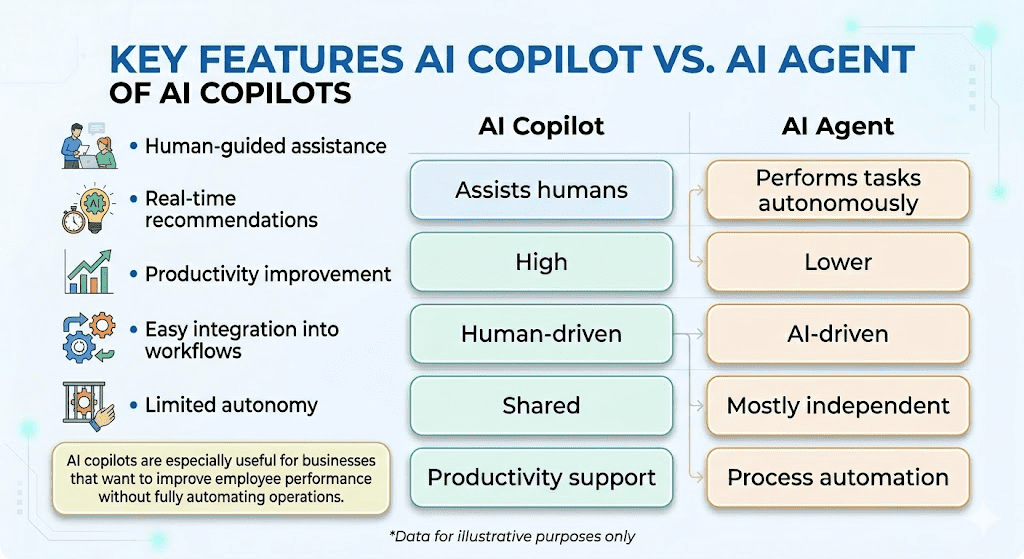
An AI agent goes beyond what an AI copilot does; rather than just helping humans, AI agents are capable of performing a task, making a decision, and taking action autonomously based on their objectives or the instructions given to them by their users. In effect, AI agents can be operated independently of humans with little or no supervision.
An AI agent is an intelligent system that can perform tasks autonomously; AI agents will replace the human who used to be the one to give recommendations on how to do it.
Today, AI agents are used by many organizations to automate business processes, minimize time spent by workers on manual processes, and provide organizations with a greater level of operational efficiency. The purpose of an AI agent is to perform tasks and facilitate processes, not to assist employees.
For example:
- An AI agent can handle customer queries without human involvement.
- An AI agent can schedule meetings automatically.
- An AI agent can monitor inventory and place orders when stock is low.
- An AI agent can analyze data and generate reports.
- An AI agent can manage workflows across multiple systems.
Unlike AI copilots, AI agents do not always wait for human approval before taking action. This is why businesses in 2026 are exploring AI agents to improve productivity, automate routine operations, and streamline business processes.
The Core Difference Between AI Copilots and AI Agents
The biggest difference comes down to control and autonomy.
AI copilots support humans.
AI agents act independently.
Here is a simple comparison:
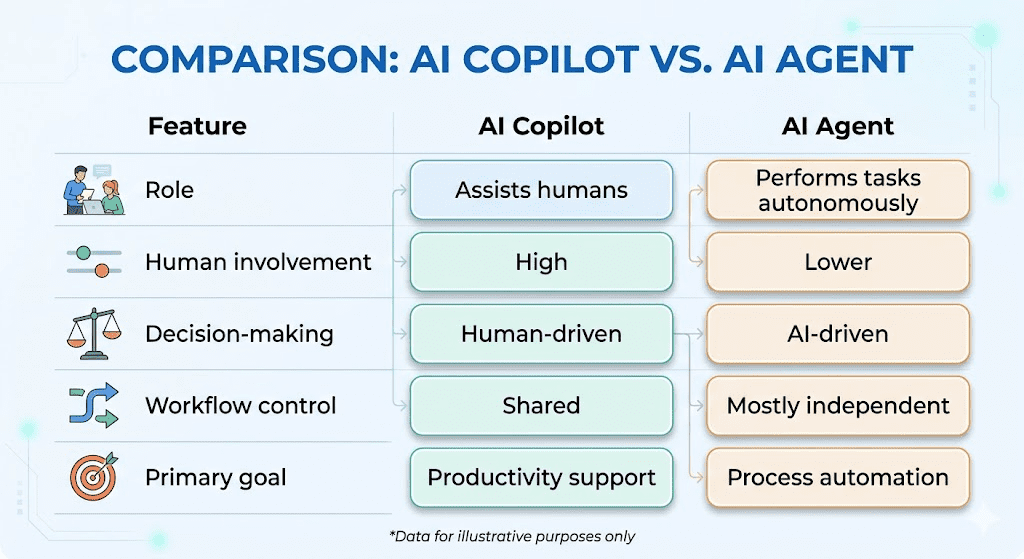
This distinction is important because not every business process should be fully automated.
Some tasks require human judgment, creativity, or approval. In those cases, AI copilots are often the better solution. Other repetitive or rule-based tasks may benefit more from AI agents.
Why AI Copilots Became Popular First
AI copilots became popular faster because businesses were more comfortable using AI as a support tool rather than giving it full control. Employees could still stay involved in the process while using AI to save time and improve productivity.
Think of it as AI helping people do their jobs better, not replacing them completely.
For example, a marketing team might use an AI copilot to create blog outlines, generate social media captions, summarize research, or draft emails. The AI helps speed up the work, but the team still reviews and approves everything before it goes live.
This balance between AI assistance and human control made copilots easier for businesses to adopt. Many companies also preferred AI copilots because they could fit into existing workflows without requiring major operational changes or complex automation systems.
Why AI Agents Are Growing Rapidly in 2026
Businesses are moving toward greater automation to handle growing workloads more efficiently. Rising operational costs, labor shortages, and the pressure to work faster are pushing companies to adopt smarter and more autonomous AI systems.
This is where AI agents are gaining attention. Unlike AI copilots that mainly assist with individual tasks, AI agents can manage entire workflows on their own. They can handle processes from start to finish, helping businesses save time, reduce manual work, and improve overall efficiency.
For example, in customer support, an AI agent may:
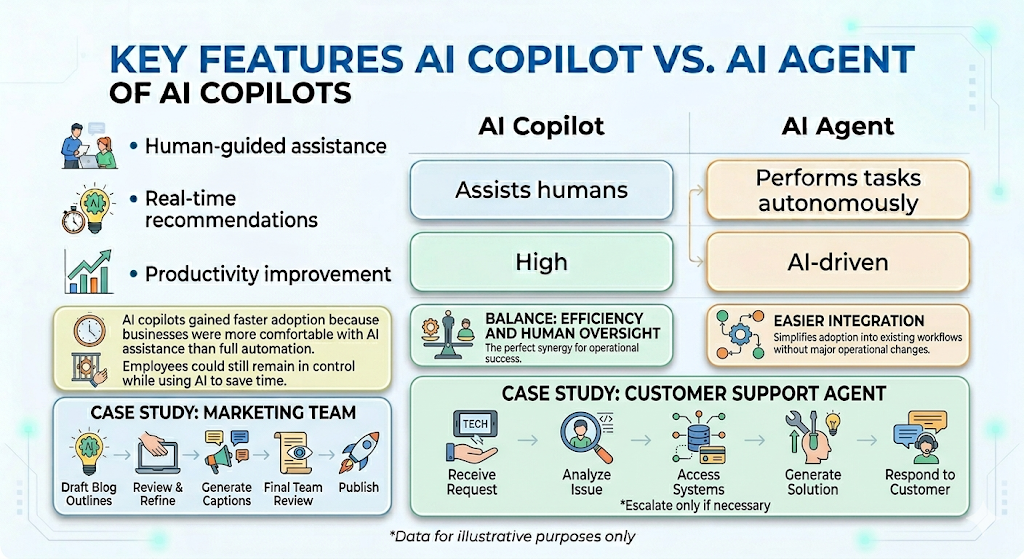
This reduces workload for human teams and improves response times.
Industries such as finance, healthcare, logistics, SaaS, and e-commerce are increasingly investing in AI agents for operational efficiency.
Business Areas Where AI Copilots Work Best
AI copilots are ideal for tasks that require collaboration between humans and AI.
Common Use Cases
AI copilots are especially useful in tasks that require human creativity, communication, and decision-making. Many businesses use them to support everyday work and improve productivity without removing human involvement.
Some common use cases include:
- Content creation
- Software development
- Email drafting
- Data analysis support
- Meeting summaries
- Customer support assistance
- Research and brainstorming
These tools help employees work faster and more efficiently while still keeping humans in control of the final decisions. Businesses that rely heavily on creativity, collaboration, or strategic thinking often benefit the most from AI copilots.
Business Areas Where AI Agents Work Best
AI agents perform best in structured and repetitive workflows where decisions follow predictable patterns.
Common Use Cases
Automated tasks and repetitive tasks form the foundation of AI agent applications. Organizations leverage AI agents to reduce the manual effort needed to perform those activities effectively and efficiently and to improve overall business processes by automating routine workflows with minimal human participation.
Common use cases for AI agents include:
- Workflow automation
- Customer query handling
- IT monitoring
- Inventory management
- Lead qualification
- Appointment scheduling
- Data processing
- Internal operations management
Organizations are implementing AI agents to support their need to grow their operating capacity, increase volume capacity through improved processes, and reduce the amount of manual work required to complete their daily tasks.
Challenges Businesses Must Consider
While both technologies offer benefits, businesses should also understand the challenges.
Challenges with AI Copilots
- Employees may become overly dependent on suggestions
- AI-generated information may contain errors
- Human review is still necessary
- Integration costs can vary
Challenges with AI Agents
- Risk of incorrect autonomous decisions
- Security and privacy concerns
- Complex implementation
- Need for strong monitoring systems
- Compliance and governance issues
Businesses should avoid rushing into full automation without clear oversight.
Will AI Agents Replace AI Copilots?
Many companies will use AI copilots as well as AI agents together because they do different things.
AI copilots are designed to help employees; they help employees get work done quicker and more efficiently. AI agents are designed to do things like automate tasks and manage workflows on their own. Moreover, both of these types of technology typically work best together when they are used as part of an overall AI strategy.
For instance:
A marketing staff member could use an AI copilot to come up with ideas for a marketing campaign. An AI agent could then schedule the marketing campaign, follow its success, and produce reports about its success all without any help from the marketing staff member.
The combination of these technologies will enable companies to improve productivity and automation, leveraging both at the same time.
Innovation allows businesses to improve both productivity and automation at the same time.
How Businesses Should Decide in 2026
Choosing between AI copilots and AI agents depends on what a business actually needs to achieve. Not every task requires full automation, and not every workflow needs human involvement. The right choice often depends on the type of work, the level of control required, and the company’s long-term goals.
Businesses should ask questions like:
- Does this task require human creativity or judgment?
- Is the workflow repetitive and rule-based?
- How much autonomy is acceptable?
- What level of risk is involved?
- Do employees need assistance or full task automation?
If teamwork, creativity, and human decision-making are important, AI copilots are usually the better option because they support employees rather than replace them. On the other hand, if the goal is to automate operations, reduce manual work, and improve efficiency, AI agents may provide greater value.
The Future of AI in Business
The future of AI will likely involve a mix of both AI copilots and AI agents working together. Instead of completely replacing employees, AI will become a regular part of everyday business workflows.
In many organizations, employees may use AI copilots for support, creativity, and decision-making while AI agents handle repetitive tasks and automated processes in the background. This combination can help businesses improve productivity while still keeping human expertise involved where it matters most.
Companies that successfully balance automation with human oversight are likely to gain the biggest advantage in the coming years. The real goal is not to adopt AI simply because it is trending but to use it in practical and responsible ways that solve real business challenges.
Conclusion
AI copilots and AI agents are transforming the way modern businesses operate, but they are built for different purposes. As more organizations adopt AI-driven technologies, the conversation around how Copilot & agentic AI transform enterprises is becoming increasingly important. Many businesses are also integrating these AI capabilities into a Microsoft Dynamics 365 solution to improve productivity, automate workflows, and streamline daily operations. While AI copilots focus on helping employees work faster and make better decisions, AI agents are designed to automate workflows and complete tasks more independently.
Understanding this difference is becoming increasingly important for businesses in 2026. Companies that carefully assess their workflows, employee needs, and automation goals will be better prepared to use AI in the most effective way.
Instead of seeing AI copilots and AI agents as competitors, businesses should focus on how each solution adds value. In many cases, the future of AI will involve both working together to create smarter, more efficient business operations.