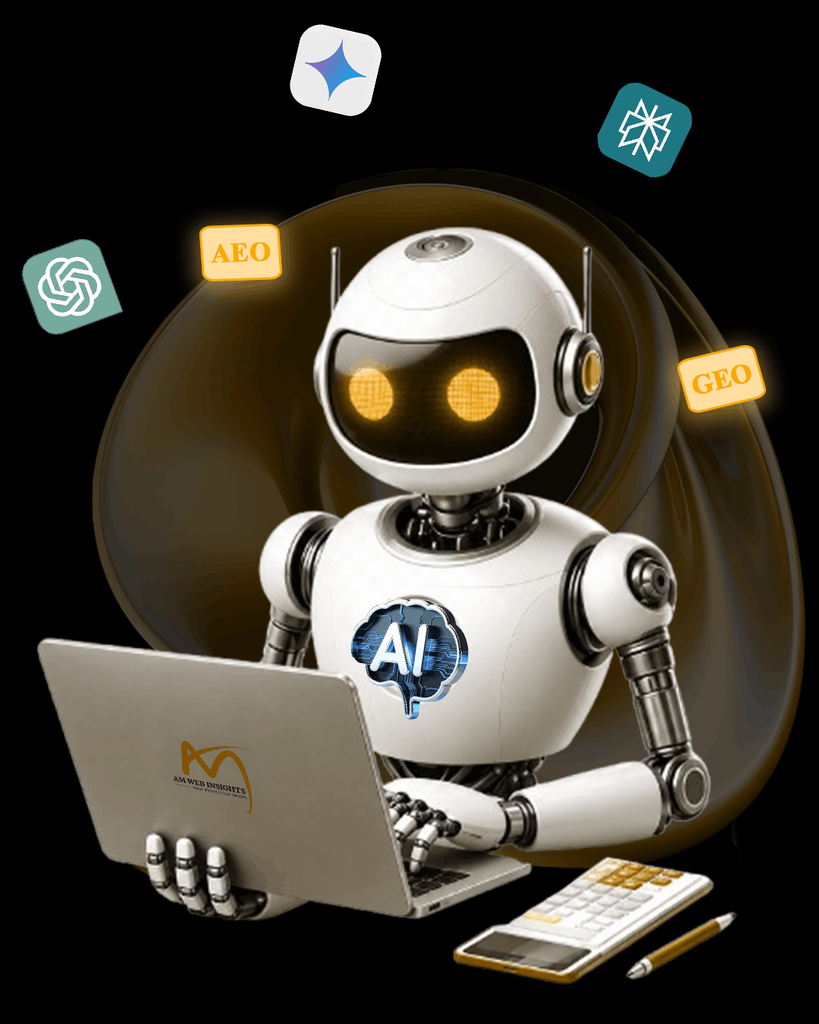
Is your business ready for a world where people ask ChatGPT instead of Googling? Good AI SEO optimization services get your brand found in Google AI Overviews, Google AI Mode, ChatGPT, and Perplexity.
Here’s a real example. A law firm owner hired AM Web Insights for SEO and digital marketing. She said the results were very satisfactory. That’s a client talking, not a sales pitch. Google Search keeps changing. People now get answers right on the results page. Some never click at all. So ranking alone won’t cut it. You want to be the source the AI quotes.
What’s the Difference Between Traditional SEO and AI SEO?
Think of traditional SEO as the old playbook. You picked a keyword, built a page around it, and got links pointing back. Then you waited and watched the rankings crawl up.
AI SEO still uses that playbook. But it adds a few new plays. It looks at what a person really means when they type a question. It spots trends while they’re still warming up. And it helps AI tools like ChatGPT and Google AI Overviews see your page as a source worth quoting.
So the basics still matter. They’re just no longer the whole game.
Here’s the quick side-by-side.
Traditional SEO: Manual keyword mapping. Updates after rankings drop. A focus on Google’s standard blue links.
AI SEO: Machine learning reads search intent. Changes happen as search shifts. The focus covers ChatGPT, Claude, and Google AI Overviews.
Same goal. Different playing field.
Which AI SEO Optimization Services does your Business Need?
Most businesses don’t need everything on day one. But it helps to know what’s on the menu.
- LLM and answer engine optimization (AEO): Your brand gets cited as a trusted source in ChatGPT, Perplexity, and Claude.
- Google AI Overviews targeting: Your content is set up so Google’s AI summary boxes can pull in your business.
- Predictive keyword and intent research: Machine learning spots rising search trends before your rivals do.
- AI-enhanced technical SEO: Schema markup, speed checks, and code audits run at scale.
- Human-guided content: AI speeds up the draft. A real expert edits every page.
Let’s talk about Google AI Mode for a second. It answers questions in a chat-style format, and it pulls from pages it can read and trust. Google AI Mode SEO means shaping your pages so that Google’s AI can understand them and quote them. Good SEO for Google AI Mode starts with clear answers, clean structure, and facts stated plainly.
An AI Powered SEO service should speed up the boring parts. Think audits, data crunching, and schema. It shouldn’t replace the thinking.
What Do You Actually Gain From AI SEO?
Let’s keep it real. Nobody can promise you the top spot. But here’s what a smart AI approach can do.
Speed – AI handles repetitive work fast. That means technical fixes, keyword mapping, and content drafts reach you sooner.
Wider reach – You show up on Google and in the new AI answer engines. Your customers use both, so you should be in both.
Less guessing – Tools can sift through huge piles of data. They find the exact gaps between you and the pages outranking you.
Steadier footing – Nobody is immune to Google updates. But sites built around helpful, clear, well-structured content tend to ride them out better.
Don’t just take our word for it. One Google reviewer said her website traffic went up and her rankings on Google improved after working with the team. That’s the kind of result we aim for with every project.
What Tools Sit Behind the Work?
Tools matter. But they’re only as good as the person holding them.
For content and search intent, we use platforms like MarketMuse, Frase, and Surfer SEO. They show what topics a page is missing and what questions it should answer.
For AI visibility, we use answer engine tracking tools. They watch how often your brand shows up when people ask AI tools questions in your field.
For technical work, we rely on Screaming Frog and custom scripts. They fix schema and redirects quickly, even on big sites.
A tool can tell you what’s missing. It can’t tell you what your customer needs to hear. That part takes a human.
Is AI SEO only for big companies?
Nope. A local plumber, an online store, and a software startup all face the same shift. People ask AI tools for recommendations, and those tools pick a few names.
The rules don’t change much by industry or city. Be clear. Be useful. Be easy to quote. And back it up with real proof, like reviews and case studies.
Conclusion:
AI search isn’t coming. It’s already here. People ask ChatGPT, Gemini, and Google AI Mode for advice every day, and those tools only name a few businesses. So the real question is simple. Will yours be one of them? You don’t need to overhaul everything overnight. Start with a free audit. You’ll see what’s working, what’s holding you back, and what to fix first. No jargon and no pressure. Reach out to AM Web Insights and take that first step today.
Frequently Asked Questions
What are AI SEO optimization services?
They mix smart AI tools with real people who know SEO. The idea is simple. Your site climbs on Google, and AI tools like ChatGPT, Gemini, and Perplexity start pointing to it as a source worth trusting.
Will AI SEO get my site penalized by Google?
No. Google rewards helpful, high-quality content no matter how it’s made. The risk comes from lazy, unedited content. That’s why human review matters.
How long does it take to see results with AI SEO?
It depends on your competition, your site’s age, and where you start. Most sites need a few months before the numbers move. Anyone promising overnight results is guessing.
Does AI SEO completely replace human writers and strategists?
No. AI helps with speed and data. People bring judgment, real experience, and the voice that makes readers trust you.
Does my business need a separate plan for Google AI Mode?
Not a separate plan, but it needs attention. Google AI Mode favors clear answers, strong structure, and trusted sources. Your regular SEO work should cover those from the start.